
 18 Jun, 2026
 IT Infrastructure and Digital Transformation
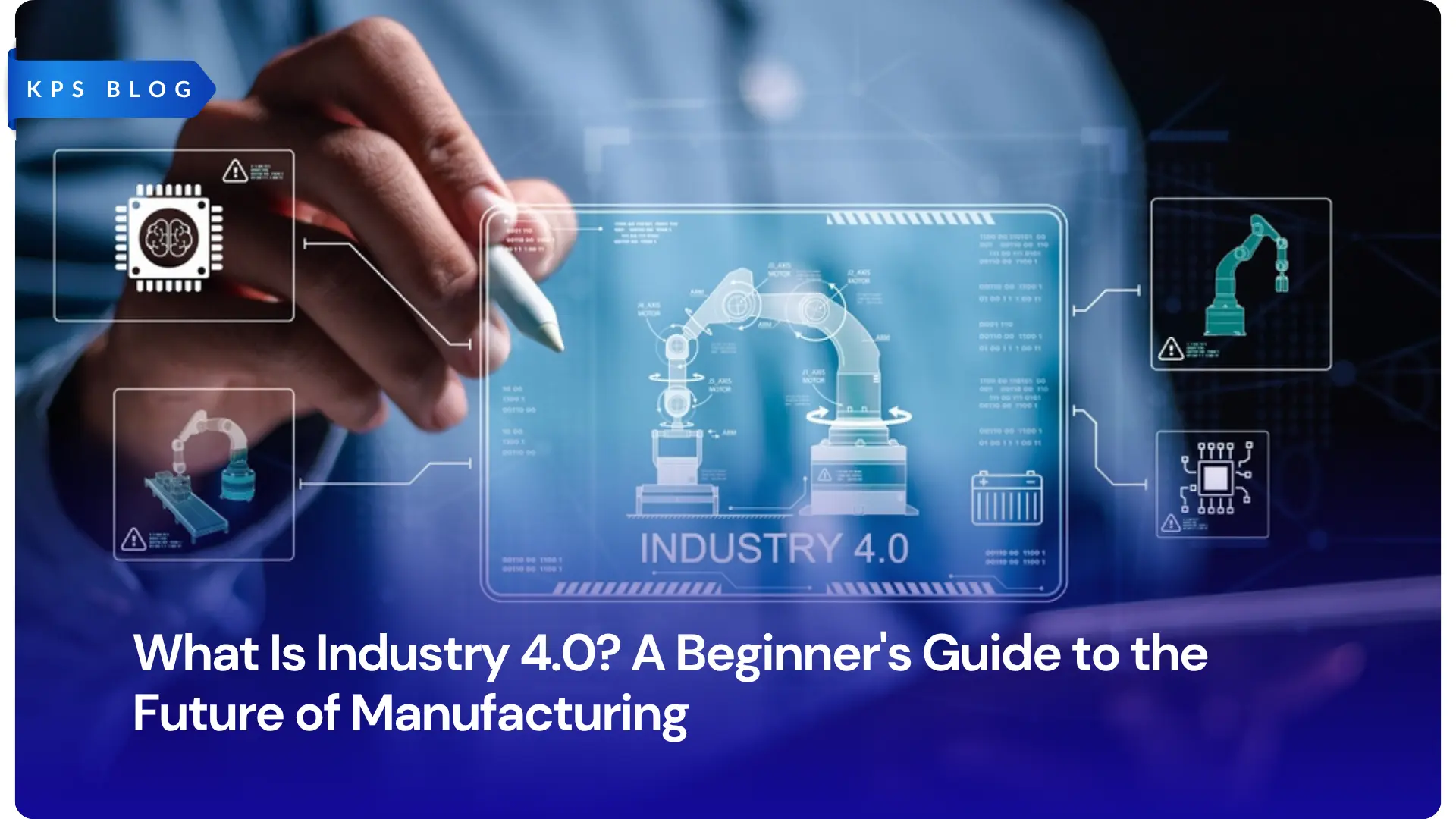
What Is Industry 4.0? A Beginner's Guide to Smart Manufacturing
Manufacturing is undergoing its most significant shift in decades. Factories that once relied on manual processes and isolated machines are now connecting equipment, data, and people in ways that were impossible ten years ago.
This shift has a name: Industry 4.0. It is reshaping how products are made, how supply chains operate, and how manufacturers compete globally. Yet for many operations leaders and engineers, the term still feels abstract, packed with technical jargon and vendor promises.
This guide strips away the noise. It explains what Industry 4.0 actually is, how it works on the shop floor, what it means for your business, and how to think about adoption before committing to any investment.
Understanding Industry 4.0 and Why It Matters?
Industry 4.0 refers to the fourth industrial revolution, a broad transformation of manufacturing driven by the integration of digital technologies into physical production environments.
The term was first introduced at the Hannover Messe trade fair in Germany in 2011, developed by academics and industry leaders advising the German federal government. Since then, it has become the global standard framework for understanding how digital innovation changes industrial operations.
To understand the "fourth" part, it helps to look at the progression:
- Industry 1.0: Steam power and mechanization (late 18th century)
- Industry 2.0: Electrification and mass production (early 20th century)
- Industry 3.0: Automation and early computing (1970s onward)
- Industry 4.0: Cyber-physical systems, real-time data, and intelligent automation (today)
What truly distinguishes Industry 4.0 is the ability to connect machines, systems, and people through real-time data flows. This creates manufacturing environments that can detect issues, respond to changing conditions, and continuously improve performance with far greater speed and accuracy than traditional operations.
The Core Technologies Powering Industry 4.0
Industry 4.0 is not a single product or platform. It is an ecosystem of complementary technologies. Here are the foundational elements that matter most for manufacturing operations:
Industrial Internet of Things (IIoT)
Sensors embedded in machines, conveyor lines, and equipment collect operational data continuously. This data streams to central systems that monitor performance, detect anomalies, and trigger responses without waiting for manual inspection. IIoT is the most common entry point for manufacturers beginning their Industry 4.0 journey.
One important consideration when deploying connected devices across a production environment is security. As IIoT networks grow, so does the attack surface. Building an IIoT Cyber Defense Playbook covers the key threats and defensive strategies that operations teams need to understand before and during deployment.
Artificial Intelligence and Machine Learning
AI analyzes large volumes of operational data to identify patterns that humans might miss. It can predict equipment failures, detect quality issues, improve production scheduling, and support process optimization.
In practical terms, this means identifying bearing wear days before a machine breakdown or detecting product defects before they reach customers.
Cloud and Edge Computing
Cloud platforms store and process large volumes of operational data across facilities and over long periods. This supports trend analysis, benchmarking, and enterprise-wide reporting.
Edge computing processes data closer to the source, allowing rapid decision-making where milliseconds matter, such as on high-speed production lines.
Advanced Robotics and Collaborative Robots
Modern industrial robots are more flexible, safer, and easier to reprogram than earlier generations. Collaborative robots (cobots) work alongside human operators on tasks that are repetitive, ergonomically risky, or require high precision, without requiring a full automation overhaul of existing lines.
Digital Twins
A digital twin is a virtual replica of a physical machine, production line, or entire facility. Engineers use it to simulate changes, test configurations, and predict outcomes before touching actual equipment. This reduces costly trial-and-error on the shop floor and accelerates troubleshooting.
Data Analytics and MES Integration
Manufacturing Execution Systems (MES) now integrate with analytics platforms to provide real-time visibility into OEE (Overall Equipment Effectiveness), cycle times, scrap rates, and production performance.
Instead of relying on historical reports, manufacturers can make decisions based on current operating conditions and live production data.
What Industry 4.0 Looks Like on the Shop Floor?
The clearest way to understand Industry 4.0 is through real manufacturing scenarios.
Consider a mid-sized automotive components manufacturer running three stamping lines. Before digitalization, maintenance was scheduled on fixed intervals regardless of actual machine condition. After installing vibration and temperature sensors connected to a predictive maintenance platform, the maintenance team began receiving alerts 48 to 72 hours before failures occurred. Unplanned downtime dropped measurably within the first operating year.
The common theme across successful Industry 4.0 initiatives is simple: they address clearly defined operational challenges. The objective is not technology adoption for its own sake, but measurable improvements in performance, quality, productivity, or visibility.
Key Business Benefits of Industry 4.0 Adoption
When implemented with clear objectives, Industry 4.0 delivers measurable operational and financial outcomes:
- Reduced unplanned downtime through predictive maintenance and real-time condition monitoring
- Improved product quality via automated defect detection and in-process control
- Higher throughput by identifying and removing production bottlenecks using live operational data
- Lower energy costs through smart monitoring and automated load management systems
- Faster product development by using digital twins and simulation to compress testing cycles
- Supply chain visibility by connecting ERP, MES, and supplier data in unified platforms
Common Challenges When Adopting Industry 4.0
Industry 4.0 adoption presents significant opportunities, but organizations should also be prepared for common implementation challenges.
Legacy equipment integration is often the first challenge. Older machines without native connectivity require retrofitting with sensors or communication gateways. This adds cost and complexity, but it is rarely a blocker for teams willing to phase the work incrementally. The financial case for acting sooner rather than later becomes clearer when you account for what legacy systems actually cost to maintain. The Real Cost of Running Legacy Applications Today examines how hidden costs accumulate in environments that delay modernization.
Data silos are a persistent obstacle across industries. When OT (operational technology) and IT systems do not communicate, data stays trapped in isolated platforms. Bridging this gap requires both technical integration work and genuine organizational alignment between engineering and IT departments.
Skills gaps are real and growing. Industry 4.0 demands people who understand both manufacturing processes and digital systems simultaneously. This combination remains uncommon in most workforce pipelines, which means training investment and deliberate hiring strategies cannot be afterthoughts.
Change management is consistently underestimated. Technology adoption fails more often because of human resistance than technical failure. Operators who feel threatened by automation or data monitoring can quietly undermine adoption if they are excluded from the planning process early on.
Industry 4.0 Opportunities for Midsize Manufacturers
A common misconception is that Industry 4.0 is only viable for large enterprises with deep capital budgets. This assumption is increasingly outdated.
Midsize manufacturers are actually well-positioned for adoption, particularly because cloud-based platforms have dramatically reduced entry costs over the past five years. Modular IIoT solutions allow teams to start with a single line or a single machine and expand incrementally based on results. The essential principle is to define a specific problem to solve first, not attempt to build a "smart factory" as a single project.
One decision that comes up early for midsize OEMs is whether to extend an existing ERP system or invest in a purpose-built solution. ERP vs. Custom IT Solutions: What's Best for OEMs? provides a practical framework for working through that decision before committing resources.
Prioritizing one or two high-impact use cases, such as predictive maintenance or real-time OEE tracking, creates demonstrable ROI that builds internal support and justifies the next phase of investment.
Emerging Trends Shaping the Future of Industry 4.0
Several developments are expected to influence the next phase of manufacturing transformation.
5G connectivity will support faster, more reliable machine-to-machine communication on the factory floor, particularly important for mobile robotics and high-frequency sensor networks that outpace current Wi-Fi infrastructure.
AI-driven autonomous production will move beyond monitoring into closed-loop control, where systems not only detect process deviations but autonomously adjust parameters to correct them in real time.
Sustainability as a design criterion is becoming standard. Energy consumption data from connected systems will increasingly feed into carbon reporting frameworks and emissions reduction programs driven by both regulation and customer requirements.
Interoperability standards such as OPC-UA and the NIST Cyber-Physical Systems Framework are maturing, making it progressively easier to connect systems from multiple vendors without extensive custom integration work.
Moving Forward with Industry 4.0
Industry 4.0 is not a future state. It is a set of technologies and practices being deployed in manufacturing facilities right now, delivering measurable results on real production floors across sectors.
The most important thing for any operations leader or engineer to understand is that Industry 4.0 adoption does not require a full transformation in year one. It requires a clear starting point, a defined problem, and the discipline to measure outcomes against a known baseline.
Rather than asking where to deploy technology first, ask where operational bottlenecks create the greatest cost, risk, or disruption. The answers will reveal the areas where Industry 4.0 can deliver the fastest and most meaningful value.
Key Takeaways
- Industry 4.0 connects physical machines with digital systems to create intelligent, data-driven manufacturing environments.
- Core technologies include IIoT, AI, cloud and edge computing, digital twins, advanced robotics, and integrated analytics.
- Real-world applications solve specific operational problems, not abstract strategic goals.
- The most common adoption barriers are legacy integration, data silos, skills gaps, and change management, not technology availability.
- Midsize manufacturers can adopt incrementally, starting with one or two clearly defined high-impact use cases.
- Advances in connectivity, automation, sustainability initiatives, and interoperability standards will continue to shape the future of smart manufacturing.